Showing posts with label albums. Show all posts

Saturday, 4 September 2010

The Addams Family


Vic Mizzy (January 9, 1916 – October 17, 2009) was an American composer for television and movies whose best-known works are the themes to the 1960s television sitcoms Green Acres and The Addams Family. He also penned top-20 songs from the 1930s to 1940s.

This is an album of incidental music from the original 1960s black and white American sitcom The Addams Family, based on the characters in Charles Addams' New Yorker cartoons. Mizzy did an admirable job on the music; it’s in keeping with the music of American TV shows of the time – think “I Dream of Jeannie” or “Bewitched” - just with added harpsichord. With a mix of blues, jazz, lounge and latin rhythms, it at times verges on Esquivel-levels of bachelor pad atmosphere, which is brilliant. I have happily put this on in the background whilst entertaining, and have drawn compliments and questions on my music choice. If you weren’t to listen to the theme tune, this would stand up on its own as a great lounge album; full of jazz flute, drum set, laid back sax and mixed chorus scatting. “Uncle Fester's Blues” could be the b-side to Quincy Jones’ Soul Bossa Nova; “On Shroud No. 9” sounds like it should have Ann-Margret purring over the top of it; and you get the theme tune twice, with and without vocals!

Download HERE (59mb)

Wednesday, 3 March 2010

The Postelfonia's BmG 223

Here is a special guest post from poet, knitter, gadabout: Señor Eddus.

Eddus curates a delightful new blog, entitled "Oh, Poetry!", about, well, poetry. Check it out!


Imagine it's the sixties and you have a new job in the National Post and Telephony Company. Also that you are Dutch. On your first lunch break you wander the halls, a little lost. But wait, there's singing coming from somewhere. You follow the sound of the female choir singing, as you get closer you hear the accompanying clumpy guitar and austere piano. You find them in an empty room, at practice. You have discovered The Postelfonia's.

They sing with the talent you'd expect from a hobbyist choir of Dutchwomen. They might be a little flat (individually and as a group) they might not quite remember which bit of the song comes next, or even how many times they're singing certain refrains, but gawd damn it, they had fun recording this.
There's such pleasure to be had from just singing, without the concern of rhythm or pitch. This is the pleasure these women are indulging in. The sound they make is not unpleasant, not at all. It's charming because of it's earnest amateurishness. Just listen to the faltering ending to "Puppet on a String", it's a terrible, but that's okay. They're a collection of well-meaning aunties, whose mistakes you can always forgive.

The whole album is a delight, but it's their medley of Mary Poppins songs that really cemented my love for The Postelfonias. It might just be because their Dutch accents are very distinct on this song, especially when trying to sound like chimney sweeps from London. The women go on to tackle "Congratulations", "Let the Sunshine In" and "Hava Naguila" with the reliability one expects from the postal service. Apart from a bit of clapping here and there, they play it very safe.

There's a lot of odd music on the internet. Most is unsettling, disturbing or confusing. But this odd music is reassuring, charming, homely. It's simplicity comforts me. I listen to this album and imagine a group of Dutch women having fun one lunchtime a week and it warms my heart.


Edward, of Oh, Poetry!, for The de Winter Family Album

Download HERE (34MB)

Sunday, 21 February 2010

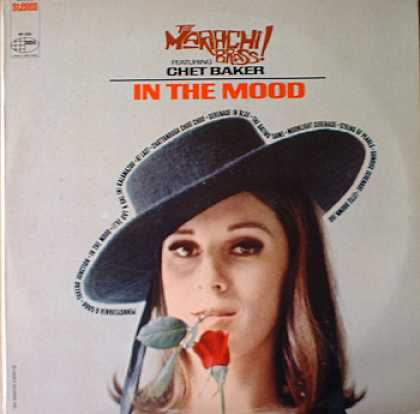
The Mariachi Brass featuring Chet Baker


When one thinks of Chet Baker, one doesn’t immediately think of “Tijuana Brass”. But by 1966 – after years of drug addiction, prison sentences, deportation, and a rather nasty case of having his teeth knocked out – Baker was in need of money. So, as was the norm for hard-up jazz musicians, he cashed in on whatever musical fad was about at the time. In 1966 it happened to be Herb Alpert’s Tijuana sound. I seem to have about five hours of music that is all people cashing in on this craze... not all of it stellar.

Four LPs were made, on which Chet played flugelhorn in order to support his family. The albums were surprisingly successful, considering that the content is often entirely devoid of Latin history. Songs such as “Pennsylvania 6-5000” and “In The Mood” are injected with only the slightest Latin flavour, making these albums delightfully kitsch lounge music. Never released to CD, you might be able to find them in your local charity shop; the covers feature beautiful females (always staring at you) in sultry locations, often sporting a large flower in their hair, or Cordobés hat about their person.

Here is a sampling of these tracks which, whilst they were made to cash in on a fad and make easy money, are still very pleasing and make excellent lounge or mood music. The Mariachi Brass’ version of “Flowers On The Wall” is one of my top played tracks out of my music collection.

Download HERE (35mb)

Saturday, 13 February 2010

Fred Buscaglione


Fred Buscaglione (23 November 1921 - 3 February 1960) was an Italian singer and actor, popular in the late 50s who cultivated a public image in both his films and songs of a slick (if comical), ruthless gangster whose only weaknesses were whiskey and women. Taking inspiration from hardboiled detective stories and the gangster of New York and Chicago, his racy songs of gangsters and their molls caught the Italian public’s attention and by the late 50s Buscaglione was a national superstar, appearing in television, film, and advertising.

Il Favoloso is essentially a Best Of collection, putting together twenty of his hits from his 1955 debut single Che Bambola (What A Babe!) which sold over a million copies with almost no promotion and catapulted him to fame, to, well, I can’t say “his later recordings”, as he only recorded up to 1959. At the age of 39, in February of 1960, Buscaglione was killed in a car accident when his pink Ford Thunderbird collided with a truck in the early hours of the morning, in front the US Embassy in Rome. This compilation features all his hits, including Teresa non sparare (Theresa, Don't Shoot!), Eri piccola così (You Were This, This Little), Guarda che luna (Look, What A Moon),Love in Portofino, Porfirio Villarosa, Whisky facile (Easy Whiskey) and Che Notte (What A Night!).

The songs are great. This isn’t an album of an actor singing (which is usually a terrible, terrible sign), rather it is an album of a singer who also acted. Buscaglione attended the Giuseppe Verdi Conservatory in Turin as a child, and as a teen he performed in night clubs, singing jazz, and was proficient in both the double bass and violin. During World War II he was incarcerated in an American internment camp, but soon found work in an allied radio station’s orchestra. It was perhaps this experience that allowed Buscaglione to experiment with American musical styles in a country that had banned most foreign music.

The American influence in his work is incredibly apparent in the tracks on this compilation. Buscaglione’s whole style was modelled on Chicago and New York gangsters, albeit with a comical touch, so the songs are replete with the hallmarks of American jazz and swing. Brushed snare, trumpets and sax all feature heavily, complimenting Buscaglione’s singing, which ranges from gravely spoken work (“Ciao Joe”, “Che Notte”) to songs where he actually displays a pleasing light-baritone (“Guarda Che Luna”). The songs are playful, brilliantly arranged songs about fights, whiskey and dames performed with aplomb by one of Italy’s most popular entertainers of the 1950s

Download HERE (74mb)

Wednesday, 14 October 2009

Mme. St. Onge


Judging by the subject material, this French-Canadian album by one Mme. St. Onge, may have been cut around 1967. On it are French renditions of popular hits from the time, such as The Beatles’ Help (re-titled “Il”) performed by a woman with no interest in tonality.

I say “woman”… the mysterious Mme. St. Onge appears an elusive character, with a strained falsetto, no other known works, and only one (rather masculine) photograph to her name. Some may posit that it is, in fact, a man doing this. If this is the case then the album has just been lifted from a mere wonder to something fucking amazing.

Evidence however seems to imply that Mme St Onge had a proper singing career in earlier times. Her real name was Francine Laplante, although she also recorded a couple of singles under the name of Maryse Marshall. It is possible that this album was done with the humour intentional to cash in the Mrs. Miller craze (St. Onge is a very common last name in Francophone Canada. Calling somebody Mme St. Onge in Canada would be similar to calling somebody Mrs. Miller in the United States).

Whatever the case regarding the provenance, the songs speak for themselves. Throughout the ten tracks Mme. St. Onge bleats her way through, supported by a competent backing band.

For fans of music to suffer by, this is a must.

Just listen to the first thirty seconds of Prends-moi (Try Me) if you need any convincing. Trust me on this.

01 Il (Help) (2:33)
02 Et maintenant (3:05)
03 C'est le Freddy (2:16)
04 Tant de choses a dire (3:10)
05 Prends-moi (Try Me) (2:53)
06 Demain (3:02)
07 C'est si triste que je voudrais pleurer (I'm So Lonesome I Could Cry) (2:05)
08 Les marionnettes (2:31)
09 La fille d'Ipanema (One Note Samba) (1:29)
10 Chez moi (Call Me) (2:50)

Download HERE(42mb)

Thursday, 30 July 2009

Dr. Hunter S. Thompson


A question & answer with Hunter S. Thompson at Boulder University in 1977. He mentions that Tom Wolfe thinks that Thompson is turning into "a brain damaged geek" and at times he might not be far off. Then again, it truly is confusing when you have someone speaking into a microphone and the speaker is on the other side of the room. The "lecture" is fascinating, in a slightly baffling way, as Thompson repeatedly cycles from jackass to genius to zoo attraction, though it is hard to tell at some points just who is antagonising and who is being made a joke of.

Download HERE (101MB)

Monday, 6 July 2009

Agnes Bernelle


Agnes Bernelle (7 March 1923 - 15 February 1999) was a Berlin-born (though soon England-based) actress and singer, famous (alongside being an international cabaret performer) for being codename “Vicki” – an OSS wartime 'Black Propaganda' radio announcer who demoralised a U-Boat Captain into surrendering via one of her targeted broadcasts. Other accolades include being the first non-stationary nude on a British stage, working with Orson Welles on the radio, collaborator with Tom Waits, being the proprietor of Ireland’s first disco…

In the 80s, Bernelle released two phenomenally titled albums. Father's Lying Dead on the Ironing Board and Mother, The Wardrobe is full of Infantrymen featuring cabaret songs that Bernelle had collected throughout her career including her own translations from German of Joachim Ringelnatz’s works. Father… is more traditional material, with obscure 1930s playwrights often supplying the lyrics, whereas Mother… features songs in the same style penned by the likes of Tom Waits, Peter Maxwell Davies and Marc Almond. The albums are camp at times, occasionally suffer from the fact that they were made in the land of 80s production, and a sixty-something Bernelle presents a voice more in keeping with Lotte Lenya than Ute Lemper (read: her range is not great and she intentionally does not try and overstretch her vocal talents, rather aims for the more theatrical delivery) but there are some real gems on these two albums. At times it is reminiscent of your grandmother disgracing herself at Christmas, but songs such as Chansonette, In Amsterdam, The Road To Marseilles, and Go To The Wall really stand up for themselves.

A little eccentric at times, but more wheat than chaff. If you’re a fan of Kurt Weill, Marianne Faithful, Gavin Friday, The Dresden Dolls, or French chansons you’d do well to check these two albums out.

Mother is HERE (75mb) and Father is HERE (48mb)


Whilst I’m pimping, I should mention that the modern-day musician most in keeping with Agnes Bernelle’s music (and I mean that in a very good way) is the manic, beautiful ukulele-toting chanteuse Patti Plinko. With a raw, captivating voice, seemingly demure appearance and disturbingly dark love songs delivered with a visceral intensity, Patti is the sound of the French Resistance in war torn Paris; all whisky, murder and high heel shoes. Check her songs out on Myspace and catch her up at Edinburgh Festival this August. You’ll be mesmerised.


Oh, and she wrote a song about me and it’s fucking ace.

Wednesday, 3 June 2009

Just Be Thankful Things Like This Exist


It's Tom Waits sung in Polish.
I don't know what else you expect me to say.
Eighteen tracks. The titles are mainly in Polish (apparently they don't have a word for "underground"?) and I have omitted the English titles because half the fun is working out just what the fuck you are listening to.

Download HERE (69mb)

Tuesday, 2 June 2009

Who's Afraid Of Virginia Woolf?


Here is Alex North’s haunting and dreamlike score from the film Who’s Afraid Of Virginia Woolf?, starring Richard Burton and Elizabeth Taylor, based on the play of the same name by homeboy Edward Albee. Replete with dialogue excerpts! Some of the cues never actually made it to film, such as the beautiful harpsichord entr’acte which was discarded because, well, the film doesn’t have an intermission.

The score swings from ethereal to full on baroque with the centre tracks employing far more dissonance than the start and finish, yet having a timeless quality to it all. As the film is so dialogue-heavy, it is easy to imagine that the score (as an underscore to dialogue) would be sidelined but North has made a highlight of the genre. And it’s backed up by being performed by the National Philharmonic Orchestra.

WARNING: the dialogue excerpts on some tracks inevitably hold MAJOR spoilers, so I’d highly recommend watching the film first. In general, I highly recommend watching the film. An extraordinary example of cinema, Taylor and Burton (married at the time!) give it their all in powerhouse performances; Taylor in particular, who chews the script and scenery up, unleashing all Hell as the venomous Martha. The definitive performance, and a rather faithful (save a trip in the car) adaptation of Albee’s stunning play.

The film was nominated for every eligible category going at the Academy Awards, and was the first film to have its entire cast nominated for awards. Only Taylor and Sandy Dennis (as the mousy Honey) won, for Best Actress and Best Supporting Actress, respectively. Burton was robbed of Best Actor, thanks to A Man for All Seasons cleaning up that year, winning six awards to Who's Afraid Of Virginia Woolf?'s five.

Download HERE

Wednesday, 27 May 2009

Django


No, not music from M. Reinhardt, but the soundtrack to one of my favourite spaghetti westerns. This bloody, macabre and surprisingly influential film by Sergio Corbucci (friend and rival to Leone) revolves around the eponymous gun runner and anti-hero, a shell-shocked veteran of the civil war. He has no horse, and drags a coffin through fields of mud. Inside the coffin is a machine gun that he hopes to trade for gold. He fetches up in a ghost town dominated by two rival gangs: Mexican bandidos and southern racists. Hilarity ensues. And by "Hilarity", I mean "A deluge of bloodshed and ear-eating". This is, after all, an Italian film from the 60s.

Over 30 (some say the count is closer to 100) unofficial sequels were filmed in the years following, thanks to Italian copyright laws being fucking absurd. Furthermore, Django has found homages being paid to it from the likes of Danzig, Joe Strummer, Rancid, Takashi Miike (whose recent film Sukiyaki Western Django is a quasi-prequel) and most famously Quentin Tarantino, who apes the controversial ear-cutting scene from Django for his Reservoir Dogs. Django, being a film verging on demented, goes further than Tarantino dared, and had the ear being fed to the victim. Oh, and the victim was a priest. Who then gets shot by his captors. Right. Yes, this got past the censors in 1966. How? After the censors requested its removal, Corbucci decided to "forget" to cut it from the film.

The music is by Luis Bacalov, Academy Award-nominated Argentine composer (you'll have heard some of his stuff if you've watched Kill Bill), and is exactly what you expect (and want) from a Spaghetti Western score, but on top of the general dramatics and atmospherics it also has a kitch and super-catchy melodramatic title track sung by Rocky Roberts (R.I.P.) to boot!

Download HERE

Saturday, 23 May 2009

William S. Burroughs


Two albums from a man who doesn't really need an introduction. Spare Ass Annie contains recitations by Burroughs of pieces from a variety of his works, including the novels Nova Express and Naked Lunch, set to a mish-mash of hip-hop, musique concrète, orchestral schmaltz, and Christmas carols... an obvious attempt at musically recreating Burroughs' "cut-up" style of surreal, obscene stream of consciousness writings. And for the most part, it works really well. Plus, hearing Burroughs' arid, monotone wheeze of a voice is always a treat. And this album really is a treat to lay back and listen to. Great bedtime music... if you don't mind listening to a geriatric heroin addict ask you, "did I ever tell you about the man that taught his asshole to talk?"

Break Through In Grey Room is a collection of Burroughs' speeches and cut-up recordings performed and recorded between 1960 and 1976. The album comprises of two things. One is simply discussions on the pieces. The other is Burroughs recordings, cut up and remixed, done analogue. What it entailed was a tape recorder recording a different player whilst randomly speeding up, slowing down, reversing, and advancing the second player. What resulted was a blubbery and blurry mess of words that surprisingly creates new sentences and phrases. Here Burroughs claims, "When you cut into the present the future leaks out." There are also a handful of field recordings mixed into the tracklist, such as "Jojouka," featuring Ornette Coleman playing in the hills of Morocco. A great little record by one of the greatest provocateurs of 20th century avant-garde literature.

Download HERE et HERE

Sunday, 17 May 2009

Exploring New Sounds In Stereo/Strings Aflame


Juan García Esquivel - Mexican bandleader, pianist and composer – was the king of what has come to be known as “Space Age Bachelor Pad Music”. On this, his fourth American released LP (here bundled alongside his fifth release), he does exactly what it says on the tin. Crafting sophisticated instrumental lounge music with jazz and Latin influences was his forte, but on this record he stretches his already varied and intelligent arrangements to include theramin, harpsichord and buzzimba (amongst others) to play alongside his usual brass section, Latin percussion, lush strings, mixed choir and virtuoso piano skills. Furthermore, it is interesting to note (for those of you unfamiliar with Esquivel) the use of voice on this album; whilst mainly instrumental, many songs do feature vocalists and choirs, but for the most part they are being used as percussion and non-lyric melodies, illustrated masterfully on a cha-cha-chá infused version of Boulevard Of Broken Dreams, replete with his signature zu-zus and ba-da-bas.

The whole album is incredibly varied, stretching from the theramin-led Spellbound (from the film of the same name), to a swinging harpsichord version of the theme from The Third Man, to fairly faithful interpretations of Greek folk tune Misirlou and Brahms’ Hungarian Dance #5. Throughout, the album is marked by fantastically creative arrangements and a constantly changing atmosphere, whilst retaining a cohesive, 60s lounge feeling.

It’s a bit redundant to say it these days, but it’s well worth listening to this in stereo. The album’s title wasn’t for nothing.

Twenty-two tracks of space age pop for your next cocktail party HERE (57mb)


Friday, 6 March 2009

Rise with me...


Nicholas Stevenson - gentleman, scholar, killustrator - has released his latest album Dearest Monstrous, and for free no less.

"If you check out one new act this month, make it Nicholas Stevenson. His songs ooze with a sinister darkness Elliott Smith would have been proud of." - The Fly

"Sweetly crazed and unusual, sometimes chilling, and sometimes plain odd - a true (slightly worrying) treat." - ANewBandADay.com

Featuring odes to places he's never been to, fuck yous to artists he doesn't particularly like, unexpected murder ballads involving children, music composed for the theatre, and two thirds of a song-cycle about zombie horses.

Come now... you'd be a fool not to.

And don't forget to check him out on his myspace, so you can put a cute face to that cute name.

http://www.myspace.com/sirnicholasstevenson